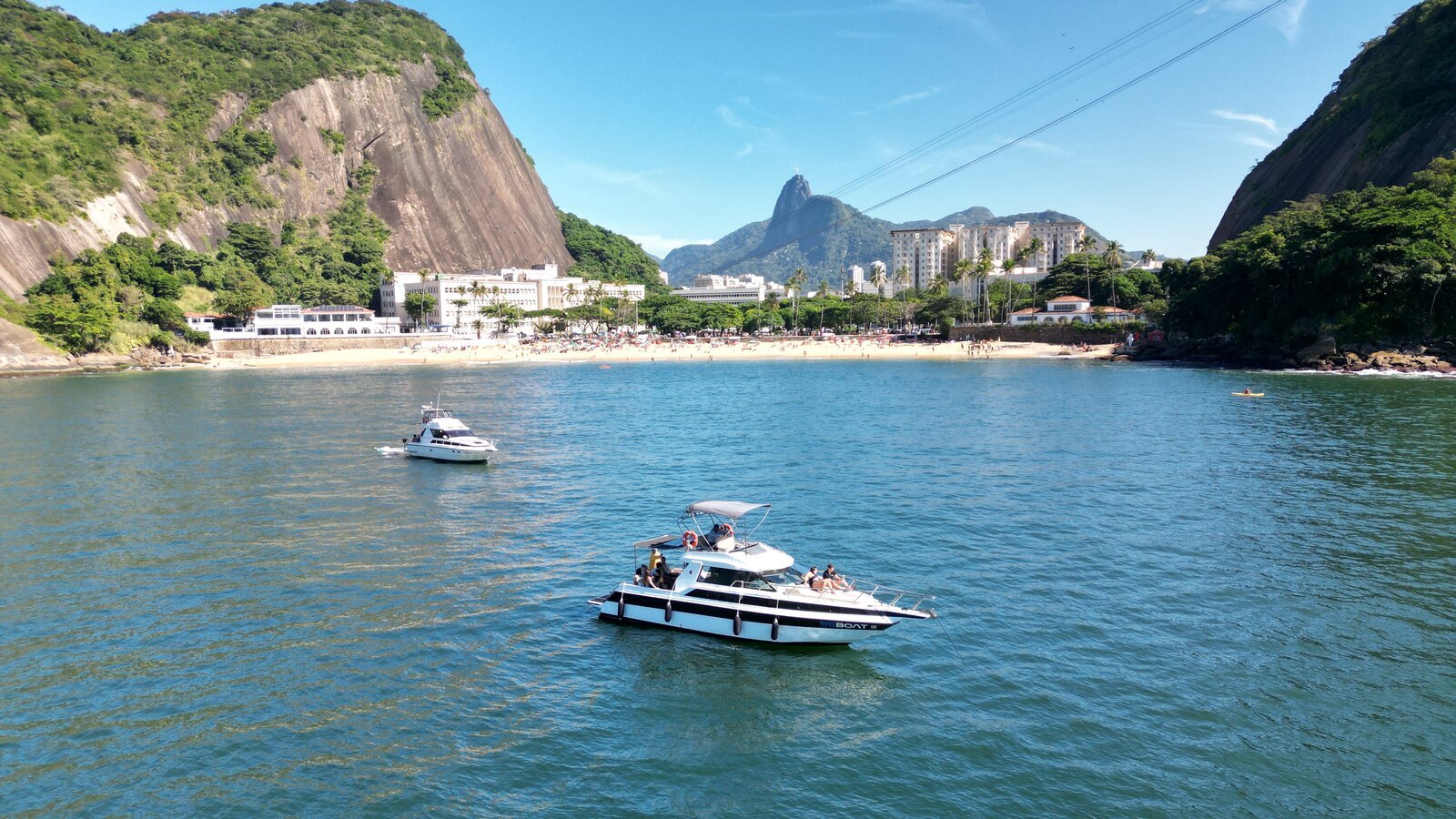
Cagarras Islands: Snorkeling, Diving and Marine Life in Rio de Janeiro

Just 5 kilometers off the coast of Ipanema, an archipelago of six islands harbors one of the richest marine ecosystems along the Brazilian coast. The Ilhas Cagarras (Cagarras Islands) are a true open-air natural aquarium: green sea turtles, dolphins, rays, colorful schools of fish and, between June and November, humpback whales that migrate all the way from Antarctica. For anyone seeking a boat trip experience that goes beyond the scenery and dives deep into Rio's marine world, this is the ultimate destination.
In this complete guide, you will discover everything about snorkeling and diving at the Cagarras Islands: the best spots, month-by-month water visibility, the species you may encounter, the rules of the protected area, and how WeBoat takes you there safely and comfortably. Let's dive in!
The Cagarras Islands Natural Monument
The Cagarras archipelago is made up of six islands: Cagarra (the largest), Palmas, Comprida, Redonda, Filhote de Cagarra, and the rocky outcrop known as Cagarrinhas. Together, they form the Monumento Natural das Ilhas Cagarras (MoNa Cagarras), a Federal Conservation Unit created by Law No. 12,229 of 2010 and managed by ICMBio (the Chico Mendes Institute for Biodiversity Conservation).
The monument was created to protect the extraordinary terrestrial and marine biodiversity of the archipelago, which includes colonies of seabirds (such as frigatebirds and boobies), insular Atlantic Forest vegetation, and, most importantly, a submarine ecosystem of rocky reefs that supports hundreds of species of fish, invertebrates, and algae.
The privileged location of the Cagarras -- between the warm waters of the Brazil Current and the cold, nutrient-rich upwelling that occurs near Cabo Frio -- creates unique conditions for marine life. This is what makes snorkeling and diving here so special: the biological diversity is astonishing for a spot so close to a major metropolis.
Marine Life: What You'll Find Beneath the Surface
The waters surrounding the Cagarras Islands harbor a biodiversity that rivals much more remote diving destinations. Over 100 species of fish have been cataloged in the area, along with invertebrates, corals, and algae. Here is what you can expect:
Green Sea Turtles
Green sea turtles (Chelonia mydas) are a constant presence in the waters around the Cagarras. They feed on the algae that grow on the rocky shorelines and can be spotted year-round, especially during the warmer months. These gentle creatures should never be touched, but they often swim curiously close to snorkelers and divers.
Dolphins
Bottlenose dolphins (Tursiops truncatus) are regularly seen near the archipelago. During the boat ride out to the islands, groups of dolphins often accompany the vessel, surfing the bow waves -- a spectacle that alone makes the trip worthwhile.
Reef Fish and Schools
The rocky shorelines of the Cagarras function as natural reefs, attracting an enormous variety of fish. Among the most common species are:
- Butterflyfish -- yellow with black stripes, always swimming in pairs
- Angelfish -- with their vibrant blue and yellow colors
- French angelfish (Pomacanthus paru) -- large and tame, great for photos
- Parrotfish -- the "parrots of the sea," with greenish and bluish hues
- Salemas, sergeant majors, and damselfish -- in dense schools along the rocky walls
- Groupers and sea bass -- on the rocky bottom, more timid
Rays and Seahorses
Butterfly rays and spotted eagle rays can be seen gliding over the sandy bottom between the islands. In more sheltered spots with dense marine vegetation, there are records of seahorses (Hippocampus reidi) -- an endangered species that finds refuge in the calm waters of the archipelago.
Corals and Invertebrates
Although the Cagarras do not have coral reefs like those in northeastern Brazil, they are home to colonies of brain coral (Mussismilia hispida) and fire coral, as well as colorful sponges, sea urchins, starfish, and anemones that cover the rocky walls. The variety of colors and shapes is stunning, especially at depths of 8 to 15 meters.
Humpback Whales: The Spectacle from June to November
Between June and November, the Cagarras Islands welcome some very special visitors: humpback whales (Megaptera novaeangliae), which migrate from the icy waters of Antarctica to the Brazilian coast to breed and nurse their calves.
The peak of the season occurs in August and September, when sightings are most frequent and it is possible to observe spectacular behaviors such as full breaches out of the water, tail slaps, and the famous whale "song," which can be heard when the boat is stopped and the engine is off.
Responsible whale watching
Brazilian law requires a minimum distance of 100 meters from whales. At WeBoat, we turn off the engine as soon as whales are spotted and allow them to approach naturally, ensuring a respectful and unforgettable experience.
The Cagarras area is recognized by the Projeto Baleias do Rio (Rio Whales Project) as one of the best humpback whale watching spots in the entire state of Rio de Janeiro. If you plan your trip between July and October, your chances of witnessing this spectacle are high.
Snorkeling at the Cagarras Islands: The Complete Guide
Snorkeling (free diving with a mask and snorkel) is the most accessible way to explore the marine life of the Cagarras. It requires no certification, is suitable for all ages, and offers an incredible experience when conditions are favorable.
Best Snorkeling Spots
- West face of Ilha Comprida -- calmer waters, ideal for beginners; shallow bottom (2-5 meters) with plenty of colorful fish
- Cove of Ilha Palmas -- sheltered from the southwest wind, excellent visibility; frequent turtle sightings
- Laje das Cagarrinhas -- for experienced snorkelers; more open waters but with the highest concentration of marine life at shallow depths
- North wall of Ilha Cagarra -- dense schools of sergeant majors and salemas along the rocks
Water Visibility by Month
Visibility is the most important factor for good snorkeling. At the Cagarras, it varies considerably throughout the year:
- December to March (summer): 8 to 15 meters -- best season. Warm water (24-27 degrees C), ideal conditions
- April to May (autumn): 5 to 10 meters -- still very good, with warm water (22-25 degrees C)
- June to August (winter): 3 to 8 meters -- variable visibility; offset by the chance to see whales
- September to November (spring): 5 to 12 meters -- progressively improving; water begins to warm up (21-24 degrees C)
Tip from our crew: the best days for snorkeling are after 3 or more rain-free days, with light wind (under 10 knots) and swell below 1 meter. Under these conditions, visibility can exceed 15 meters.
Water Temperature
Water temperature around the Cagarras ranges from 19 degrees C in winter (July-August) to 27 degrees C in summer (January-February). For comfortable snorkeling without a wetsuit, we recommend the months from November to April, when the water is above 22 degrees C. In winter, a long-sleeve rash guard already makes a big difference.
Scuba Diving at the Cagarras Islands
For those who hold a diving certification or want to try a discovery dive (an introductory accompanied dive for beginners), the Cagarras Islands offer sites with depths from 5 to 25 meters and a variety of underwater landscapes.
Dive Sites
- Ilha Cagarra wall (8-18m): rocky walls with crevices inhabited by groupers, moray eels, and lobsters. Excellent for photography
- Ilha Comprida bottom (5-12m): ideal for discovery dives; sand and rock bottom with abundant life
- Parcel das Cagarras (15-25m): a submerged rock formation between the islands; an advanced site with schools of larger fish, rays, and occasional appearances of large turtles
- Nearby shipwrecks: there are sunken vessels in the Copacabana and Niteroi area that can be combined into the route for certified divers
Certification and Dive Operators
For scuba diving, you need a PADI, SSI, CMAS, or equivalent certification. If you don't have one, you can do a discovery dive (discover scuba diving) accompanied by a certified instructor. Several dive operators in Rio de Janeiro run regular excursions to the Cagarras, and WeBoat can recommend trusted partners and help coordinate the logistics.
Diving can be combined with the Cagarras Islands boat route: you sail with WeBoat, meet the dive operator on location and, after your dive, continue the trip with stops for swimming and snorkeling.
Protected Area Rules: What You Can and Cannot Do
As a Federal Natural Monument, the Cagarras Islands have specific rules that all visitors must respect. At WeBoat, our crew knows every regulation and ensures that the trip is 100% compatible with conservation:
Essential rules of MoNa Cagarras
- Landing is prohibited on the islands -- shore access is forbidden
- Minimum distance of 10 meters from the rocky shorelines for boats
- Fishing is prohibited (recreational and commercial) within the Conservation Unit perimeter
- Feeding marine animals is prohibited
- Dumping trash or any waste in the water is prohibited -- take everything back with you
- Removing any organisms (corals, shells, animals) is prohibited
- Jet ski use is prohibited in the immediate vicinity of the islands
- Reduced speed in areas with whale or dolphin activity
These rules exist to ensure that future generations can also enjoy this natural heritage. By visiting the Cagarras with WeBoat, you contribute to sustainable and responsible tourism. Learn more about our commitment to safety and the environment on our how it works page.
WeBoat Route: From Marina da Gloria to the Cagarras Islands
The Cagarras Islands route by WeBoat is one of our most popular trips for those who want to go beyond the traditional tourist spots. Here's how it works:
Departure and Navigation
- Meeting point: Marina da Gloria, Store 06
- Total duration: 5 hours
- Navigation time: ~40 minutes to the archipelago
- Route: Marina da Gloria, Praia do Flamengo, Botafogo, Urca, past Copacabana and Ipanema with coastal views, arrival at the Cagarras Islands
What Happens on Location
Upon arriving at the Cagarras, the skipper positions the boat at the spots with the best visibility and sea conditions. You will have time to:
- Sail around the islands admiring the scenery and seabirds
- Stop for swimming and snorkeling in crystal-clear waters
- Use the floating mats and pool noodles to relax in the water
- Take photos and videos with the archipelago and the city skyline as your backdrop
- Enjoy a BBQ on board while taking in the view (if booked)
The return trip along the coast offers spectacular views of Morro Dois Irmaos, Pedra da Gavea, Cristo Redentor, and Pao de Acucar -- especially in the late afternoon, when the golden sunset light illuminates the city. Also check out our article about the sunset boat trip in Rio.
Cagarras Islands Route Prices
The Cagarras Islands route is available starting from R$ 3,600 (Monday to Thursday). The price includes everything described on our services page: fuel, skipper, coolers, Bluetooth sound system, life jackets, floating mat, and insurance. To see all boat options and prices, visit the boats page.
Recommended Boat: WeBoat Oceanic 36
For the Cagarras Islands route, we recommend the WeBoat Oceanic 36. Here's why:
- Stability in open water: the deep-V hull of the Oceanic 36 ensures a smooth ride even with swell, which is essential for the open-water stretch to the Cagarras
- Capacity: up to 14 people with ample deck space
- Stern platform: makes getting in and out of the water easy for snorkeling and diving
- Shade: large bimini top for resting between dives
- BBQ grill on board: enjoy a barbecue with views of the islands
- Price: R$ 2,900 (Mon-Fri) | R$ 3,400 (Sat-Sun)
Other boats in our fleet also do this route. Check the boat comparison to find the ideal one for your group.
Underwater Photography Tips
The waters around the Cagarras offer excellent opportunities for underwater photography and video. Here are some tips to capture the best images:
- Equipment: an underwater camera or a phone in a waterproof case will do the job. GoPro and similar action cameras are ideal for their practicality
- Time of day: between 10am and 2pm, sunlight penetrates the water best, resulting in more vivid colors
- Distance: approach fish slowly and without sudden movements. Most reef fish are curious and will come to you naturally
- Angle: shoot from below looking up to capture the silhouette of fish against the sunlight filtering through the water -- a spectacular effect
- Turtles: keep at least 2 meters away; use zoom instead of getting too close. They tend to stay still while feeding, allowing for incredible shots
- Burst mode: use continuous shooting mode for moving animals; you'll capture the perfect moment among dozens of frames
- No flash: in waters with good visibility, natural light is sufficient and avoids the reflection of suspended particles
Remember: the best underwater photos happen when the photographer is calm and patient. Set aside at least 30 minutes in the water to explore and photograph at your leisure. Check out our article on boat trip safety to make the most of every moment with peace of mind.
Frequently Asked Questions About the Cagarras Islands
Can you land on the Cagarras Islands?
No. The Cagarras Islands are a Federal Natural Monument and landing has been prohibited by law since 2010. You can sail around them, snorkel and dive in the surrounding waters, but you cannot set foot on the islands. The minimum distance for boats is 10 meters from the islands.
What is the best time of year for snorkeling at the Cagarras Islands?
The best time is from December to March, when water visibility reaches 8-15 meters and the temperature ranges from 24-27 degrees C. Summer also coincides with the period of greatest marine life activity on the reefs around the islands.
Can you see humpback whales at the Cagarras Islands?
Yes! Humpback whale season runs from June to November, with peak sightings in August and September. The whales pass through the area during their migration and it is common to spot them just a few kilometers from the archipelago. WeBoat adjusts the route to maximize your chances of a sighting.
How long is the boat trip to the Cagarras Islands?
The full trip lasts 5 hours, departing from Marina da Gloria. The boat ride to the Cagarras Islands takes approximately 40 minutes. You will have time to sail around the islands, stop for swimming and snorkeling, and enjoy the scenery at a relaxed pace. Prices start at R$ 3,600. See all options on the boats page.
Explore the Cagarras Islands by Boat
Chat with us on WhatsApp and book your trip to the Cagarras Islands with a snorkeling and diving stop. Routes starting at R$ 3,600.